Form 1099-MISC Instructions & Tax Reporting Pointers

Form 1099-MISC is an IRS information return used by businesses to report certain types of miscellaneous payments made during the tax year, such as rent, royalties, prizes, medical payments, and other income. Generally required for payments that reach applicable threshold or more, it helps ensure accurate reporting for both the IRS and recipients. Unlike Form 1099-NEC, it does not report nonemployee compensation. Businesses must issue 1099-MISC forms to recipients and file them with the IRS by required deadlines to maintain compliance and avoid penalties.
Prior to 2020, the 1099-MISC was used to report a variety of payments including payments to independent contractors. Beginning with 2020, payments made to independent contractors are reported via 1099-NEC.
Payments covered by the 1099-MISC include:

Need to make a correction? No problem! Here's how you can get started with 1099 corrections.
Review important W-2 requirements for employee filing.
To complete a 1099-MISC, you'll need to supply the following data:
Business information – Your Federal Employer ID Number (EIN), your business name and your business address.
Recipient's ID Number – The recipient's Taxpayer Identification Number (TIN) or Federal Employer ID Number (EIN).
Payment Amounts – Enter amounts paid in the appropriate box:
Section 409A Deferrals and Income - Box 12 requires you to record Section 409A deferrals and income, which pertains to non-qualified deferral compensation plans.
State and Local Information - Enter the amount of state tax withheld (Box 16), the state/payer's state number (Box 17) and state income (Box 18).
There may be instances in which you need to provide both a 1099-MISC and 1099-NEC to the same individual, however that will depend on the business conducted with them in that year. If you are unsure it’s always best to consult a tax attorney in order to remain compliant.
Get additional information on completing a 1099-MISC form here.
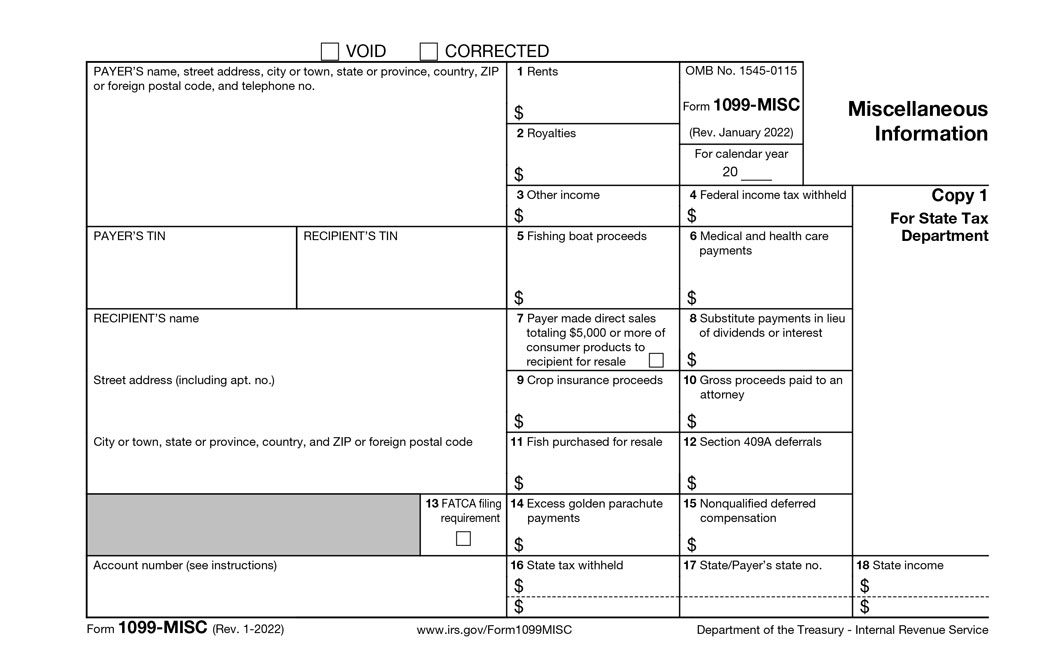
The 1099-MISC is a multi-part form that is handled as follows:
Copy A — File with IRS by the paper or electronic-filing deadline.
Copy 1/State Copy — File with the appropriate state taxing authority, if applicable.
Copy B — Distribute this copy to individuals, who then file it with their federal income tax return. You will meet the IRS’ distribution requirement if the form is properly addressed and mailed on or before this due date.
Copy 2 — Distribute this copy to individuals. If applicable, individuals will then file this copy with their state taxing authority.
NOTE: When the due date falls on a weekend or legal holiday, the form due date is moved to the next business day.
Form 1099-MISC is used to report certain types of income paid outside of traditional wages. This may include payments such as rent, royalties, prizes, and other miscellaneous income made in the course of business.
A 1099-MISC is typically required when specific types of payments—such as rent or royalties—meet IRS reporting thresholds. For example, royalties may be reportable at lower amounts, while other payments may require higher minimums depending on the category.
A 1099-MISC is used for miscellaneous income, while a 1099-NEC is used specifically for nonemployee compensation. Payments to independent contractors for services are generally reported on a 1099-NEC rather than a 1099-MISC.
Common payments reported on a 1099-MISC include rent, royalties, certain medical or legal payments, and other miscellaneous income categories. The exact reporting requirements depend on the type of payment and how it is classified by the IRS. Details can be found here: https://www.irs.gov/forms-pubs/about-form-1099-misc.
Yes, in some cases a business may need to issue both forms to the same recipient. This depends on the types of payments made during the year, as different payment categories are reported on different forms.
Free to try.
You only pay when you're ready to file.